Sustainable Tropics: Costa Rica
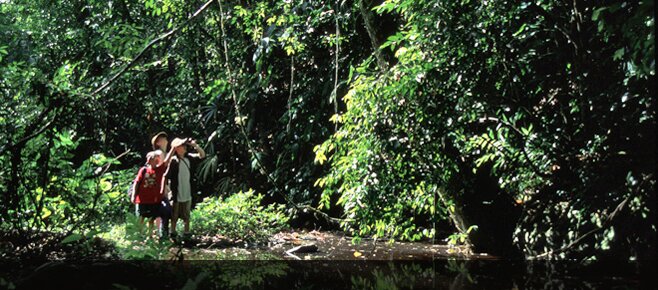
Costa Rica is one of the best examples of sustainable development in the world. On this educational workshop, students will study conservation and sustainable development as they visit tropical montane forests, cloud forests and tropical dry forests. Along the way, students will see some of Costa Rica’s amazing diversity, from parrots to howler monkeys and poison dart frogs to bats.
Students learn field science techniques, delve into cultural studies and work hand-in-hand with Costa Rican students on a service project. They study ecotourism and learn about sustainable and fair trade issues. Preparatory curriculum explores Costa Rican culture, biodiversity, fair trade and current issues in conservation.
Northern Colorado educators interested in World Aware, check out the special programs section of this page at top right!
Sample Itinerary
Day 1
Day 2
Day 3
Day 4
Day 5
Day 6
Day 7
Day 8
Day 9
Service Project, Sarapiqui River Exploration and Pineapple Plantation
Day 10
After arriving in San Jose, we settle into a comfortable hotel, eat and get some rest.
This morning we visit the National Biodiversity Institute (INBio). INBio is a private research and biodiversity management center, established in 1989 to support efforts to gather knowledge on the country's biological diversity and promote its sustainable use. During our educational tour,we are introduced to the diverse ecosystems of Costa Rica. We depart by van for our trip to Ostional. Upon arrival we receive an orientation to the basic lodging facilities and prepare for our overnight turtle research experience. We spend several hours observing and studying turtles tonight.
Located on the western coast of Costa Rica, Playa Ostional is home to a national wildlife refuge created to protect an important nesting beach for Olive Ridley Sea Turtles. The best time to visit Ostional is just before or during an arribada (when hundreds of turtles nest). These occur, as a general rule, at the start of the last quarter moon. The best months to see the biggest arribadas are between July and December. Contact us for details on turtle activity in different months.
We have a slow morning after a long night of observing turtles. This afternoon we participate in a service project alongside local community members. Depending upon community needs, we may engage in a beach cleanup, a project at the community school or other communal area. Regardless of the project, we have a great time getting to know local community members and working hard together to complete a project that is useful to the community.
We spend this evening observing and studying turtles.
We depart after breakfast for Monteverde, a remarkably diverse area of cloudforest that offers opportunities for visitors to see many species of small mammals, birds and much more. After arriving and settling into our hotel, we head out on a night hike to look for wildlife.
We start the day on an early morning hike in search of quetzals. These stunning birds are often seen in the cloudforests of this region. After breakfast we learn about canopy ecology as we explore the canopy, a traditionally inaccessible zone of the forest. We have the opportunity to experience the thrill of ziplines and the chance to look more closely at the forest from a series of elevated walkways. This afternoon we learn about ecotourism in the area from a local expert. In the evening, we relax and enjoy some leadership activities that help us soak in everything we have learned so far.
Today, we set out on a long hike through the Monteverde reserve. Home to everything from resplendent quetzals to jaguars, Monteverde's well protected forests have an amazing diversity of plants and animals. We hope to see a lot of that diversity today! We use the afternoon to conduct a research activity.
We head along the shores of Lake Arenal to the Sarapiqui region of Costa Rica today. Along the way, we stop at a restaurant to enjoy lunch in Arenal. We end the day at the Tirimbina Reserve in Sarapiqui with an exciting bat observation activity and then fall asleep to the sounds of the forest.
From our beautiful base at the top of a hill overlooking the Tirimbina Reserve, students continue studying tropical ecology and conservation. In the morning, we visit La Selva, one of the most important sites in the world for scientific research on tropical forests. Established in 1968 as a biological reserve, it protects 3,900 acres of tropical and premontane forest and connects to the Brauillo National Park (100,000+ acres). At La Selva, we are likely to see some of the mammals of the tropical forest such as monkeys and coatimundi. In the afternoon, we return to Tirimbina for a chance to conduct a research activity and enjoy a night walk in search of frogs.
Today we partner with the Sarapiqui Conservation Learning Center for a service project with a local community. Like Ostional, the communities in this region are rural and typically impoverished. We work on a school improvement project alongside local students. This afternoon we explore the Sarapiqui River by boat. We gain a different perspective of the forest from the riverside and observe wildlife as we float. We finish the day with a visit to a pineapple plantation to learn about this important export crop. We enjoy our last evening at La Selva and prepare for tomorrow’s journey home.
We head back to San Jose today, stopping along the way (if time permits) to see some of the beautiful handicrafts of Costa Rica. Crafts might include oxcarts, painted bowls and trays, natural wood serving utensils, tables, jewelry boxes and carvings. We head home today!